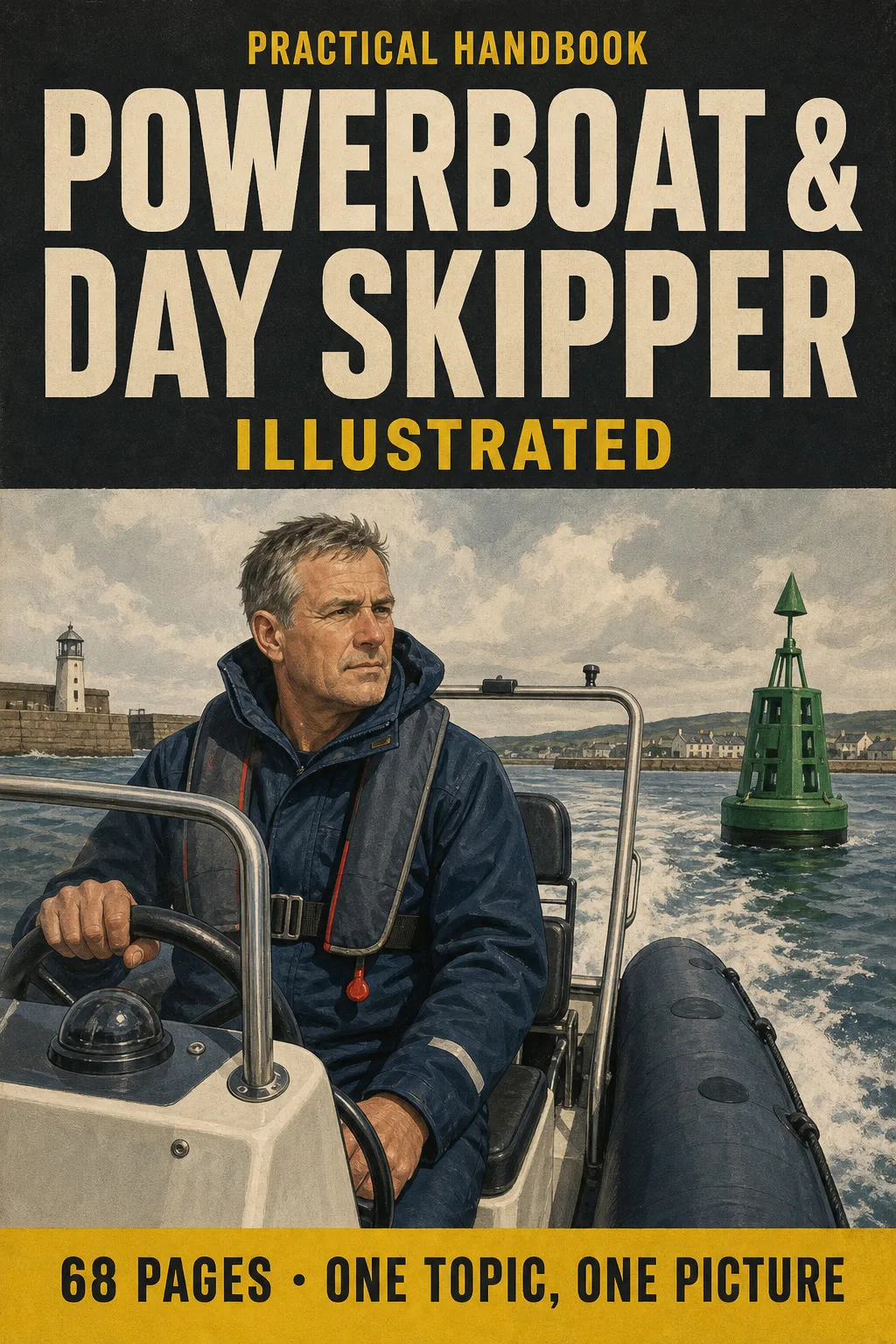
📄 Digital book in PDF · read it on your phone or print it
Who gives way, navigation lights, IALA Region A buoyage, cardinal marks, chart work, tides and the rule of twelfths, the Mayday call and man overboard. One topic per page, the drawing first, then what to remember: 68 illustrated pages plus 2 free books, as a PDF by email you can print. 68 illustrated pages.
🔒 Secure checkout · PDF by email · 30-day guarantee
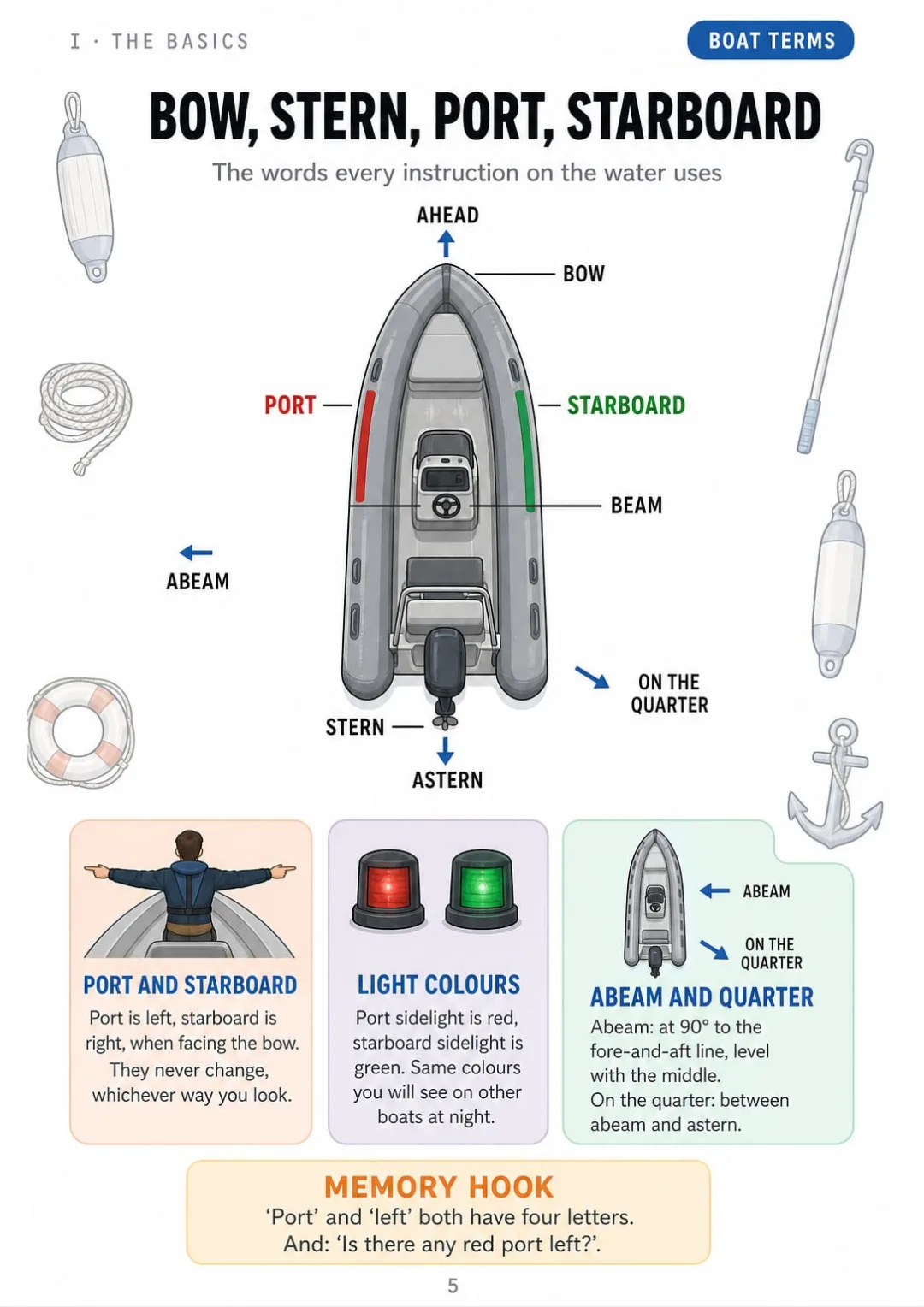
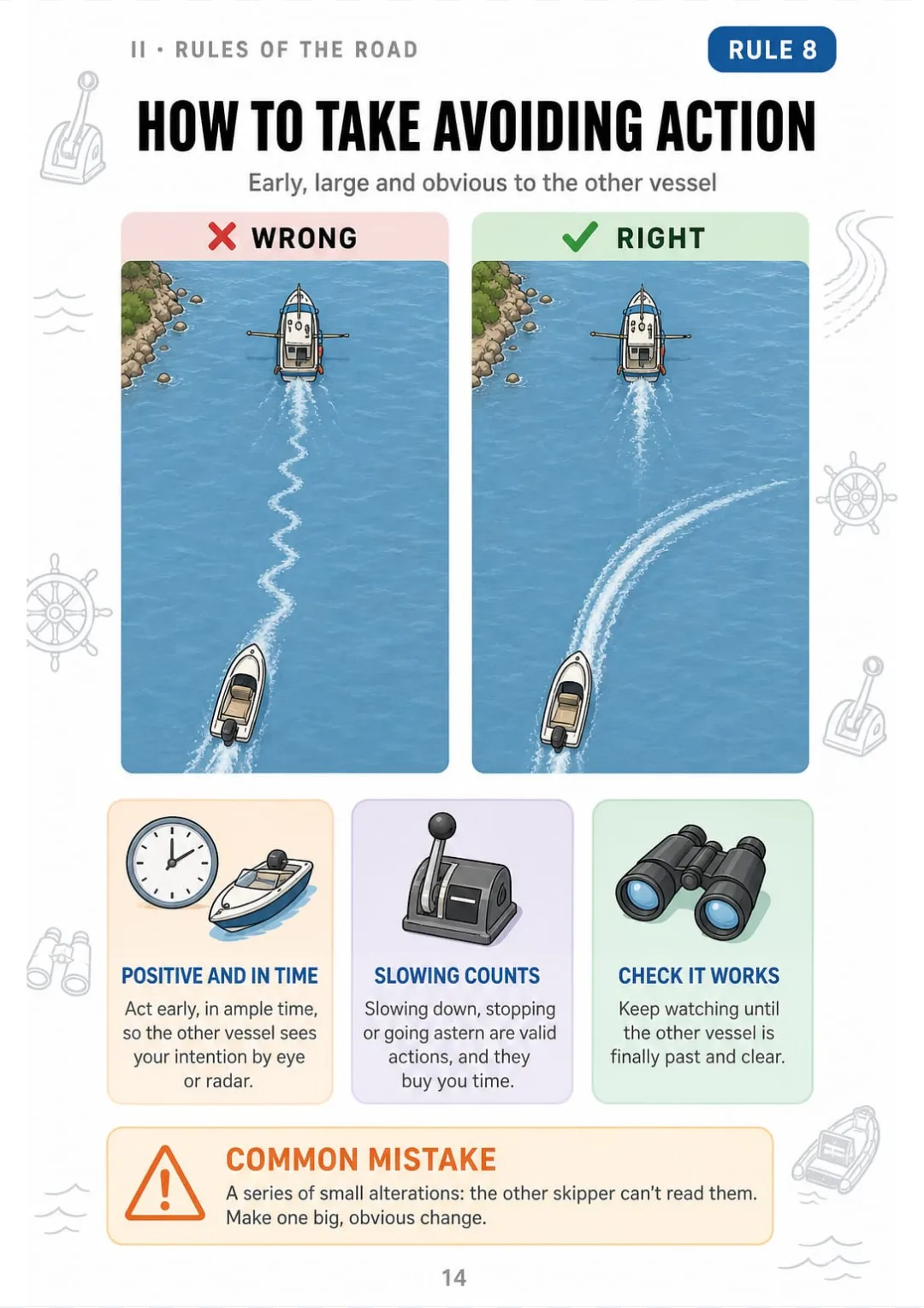
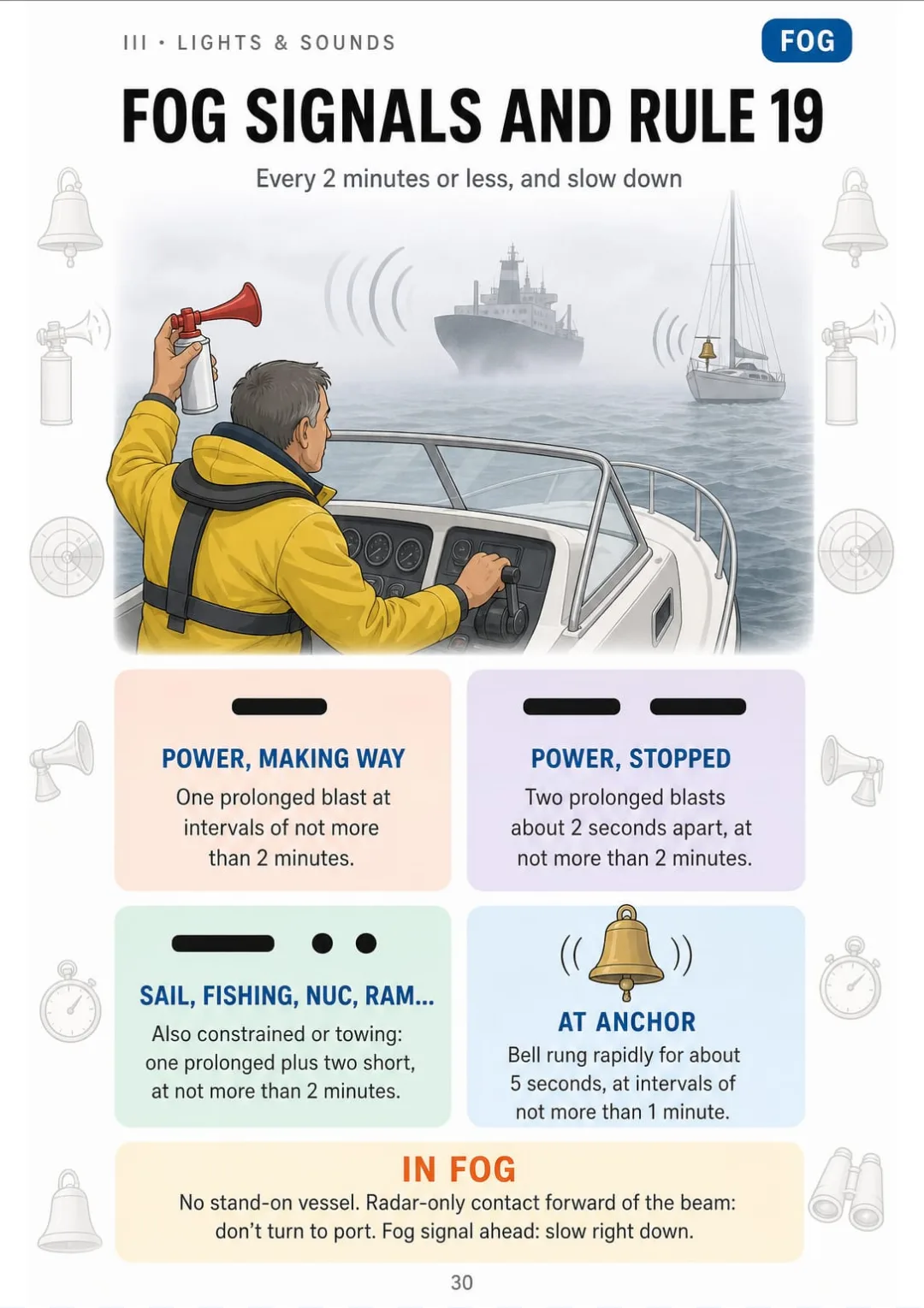
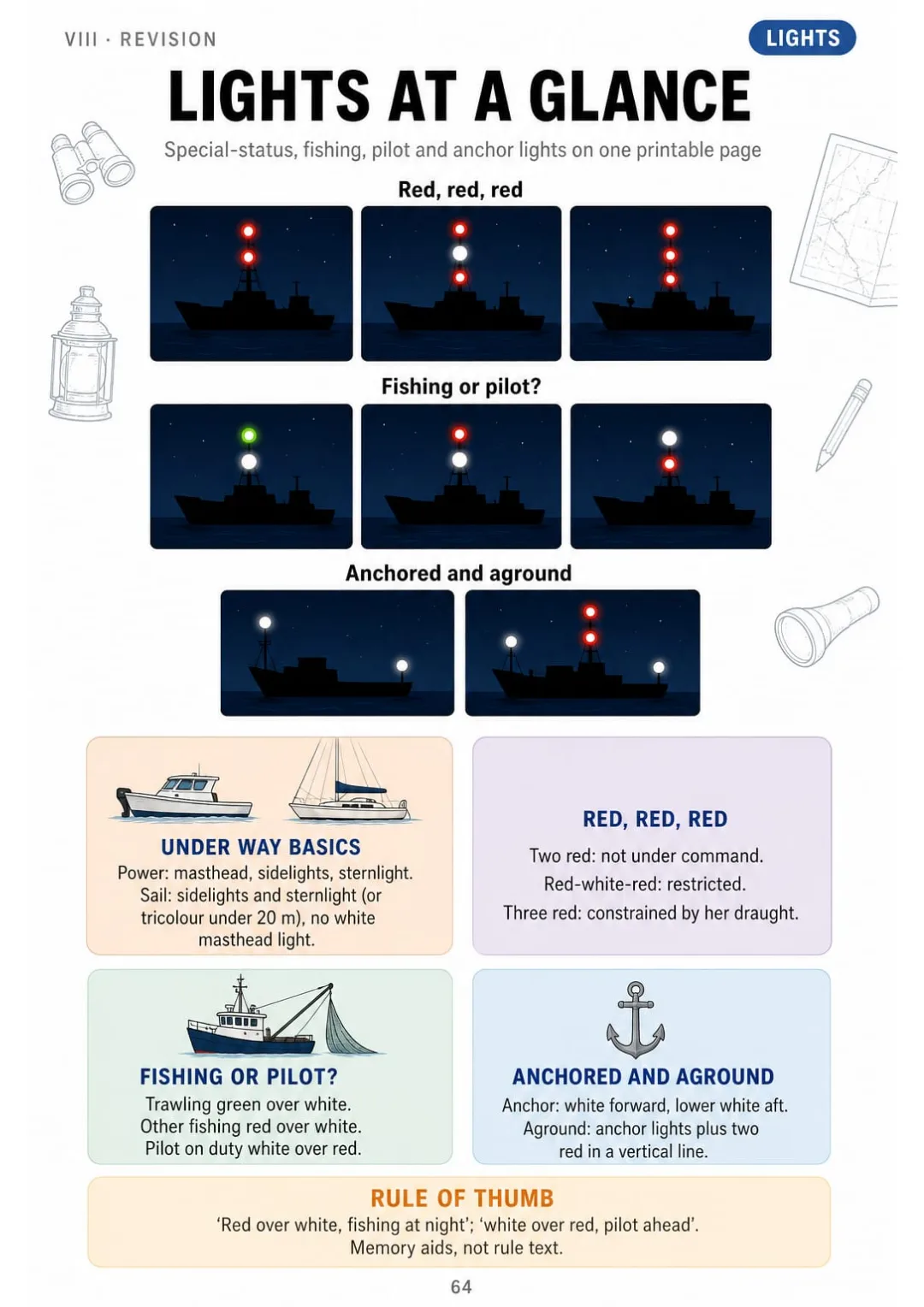
Every page has one big drawing and a box with the rules and numbers you need to know:


Swipe to see more →
These are real pages from the book. The table of contents is the full one: 8 parts and 64 topics.
You're heading back in after dark. Up ahead you see a white masthead light and, lower down, a red sidelight. The instructor beside you asks: which way is she heading, and who gives way?
You've read Rule 21. But the manual gives you the arcs as numbers inside long paragraphs: 225, 112.5, 135. Degrees in a sentence don't turn into a picture in your head, so out on the water you end up guessing.

In the book, Rule 21 is one boat drawn from above: the white masthead light sweeping 225° forward, each sidelight covering 112.5° in red and green, the sternlight filling the 135° behind. You see which light shows from where, in one look.
The same goes for who gives way in a crossing, the four cardinals and their topmarks, the rule of twelfths and the Mayday call word by word. Each one has its own page.
So the next time a red sidelight shows on your starboard bow in a crossing, you know you're seeing her port side and you're the one who keeps clear. And if it's two all-round lights, white over red, you know it's a pilot boat on duty, not a motor cruiser.

Your boat and the basics, rules of the road, lights, shapes and sounds, IALA Region A buoyage, charts and navigation, tides, weather, VHF and emergencies, and revision checklists: 68 pages, all illustrated.
Think of it this way:
It's a grey Saturday on the Solent and a yellow-and-black buoy appears off the bow. You have a few seconds to decide which side to pass.
You don't open a book now: you've already seen the cardinal marks page, the four buoys drawn round a danger, north, east, south and west, each with its two black cones and its colours. You pass on the side the name tells you.

The night before you go out, you flick through the lights pages once more: fishing, pilot, towing, anchored. Ten minutes, and they're back in place.
Powerboat & Day Skipper Illustrated is 8 parts and 64 topics on 68 illustrated pages, with lights and buoyage at a glance, the most frequent mix-ups and a pre-departure checklist at the end.
What you see drawn, you don't have to memorize.
Bow, stern, port and starboard, which course each page is for, displacement or planing, the kill cord, prop walk, the knots you actually use and the rule of thirds for fuel.
Lookout and safe speed, risk of collision, avoiding action, head-on, crossing and overtaking, give-way and stand-on, the pecking order, sail meets sail, narrow channels and traffic schemes.
The four basic lights and their arcs, power and sail at night, reading the aspect, NUC, RAM and constrained by draught, fishing, pilots, anchored, aground, towing, sound and fog signals.
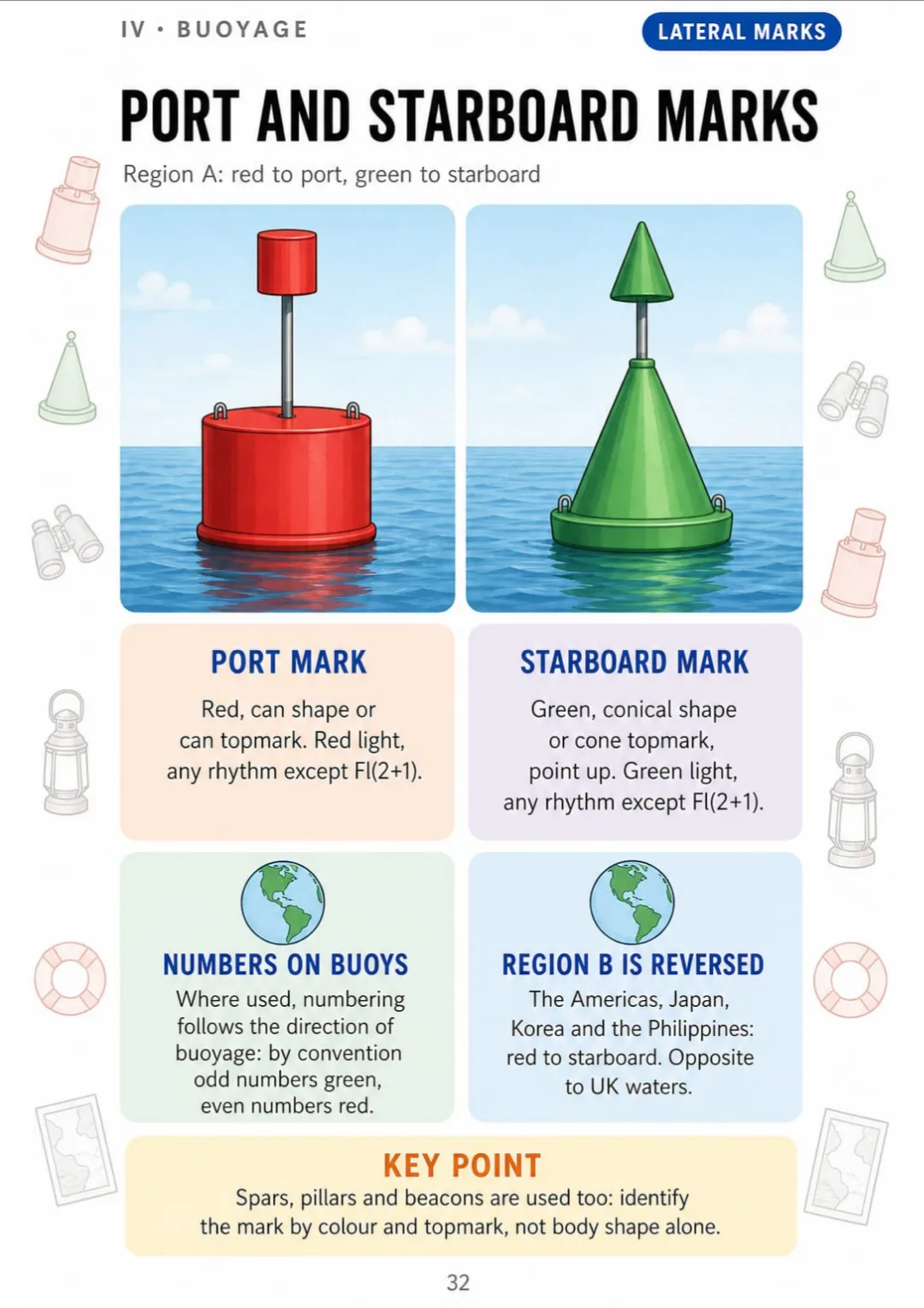
Direction of buoyage, port and starboard lateral marks, preferred channel marks, the four cardinals and their lights, which side to pass, isolated danger, safe water and special marks.
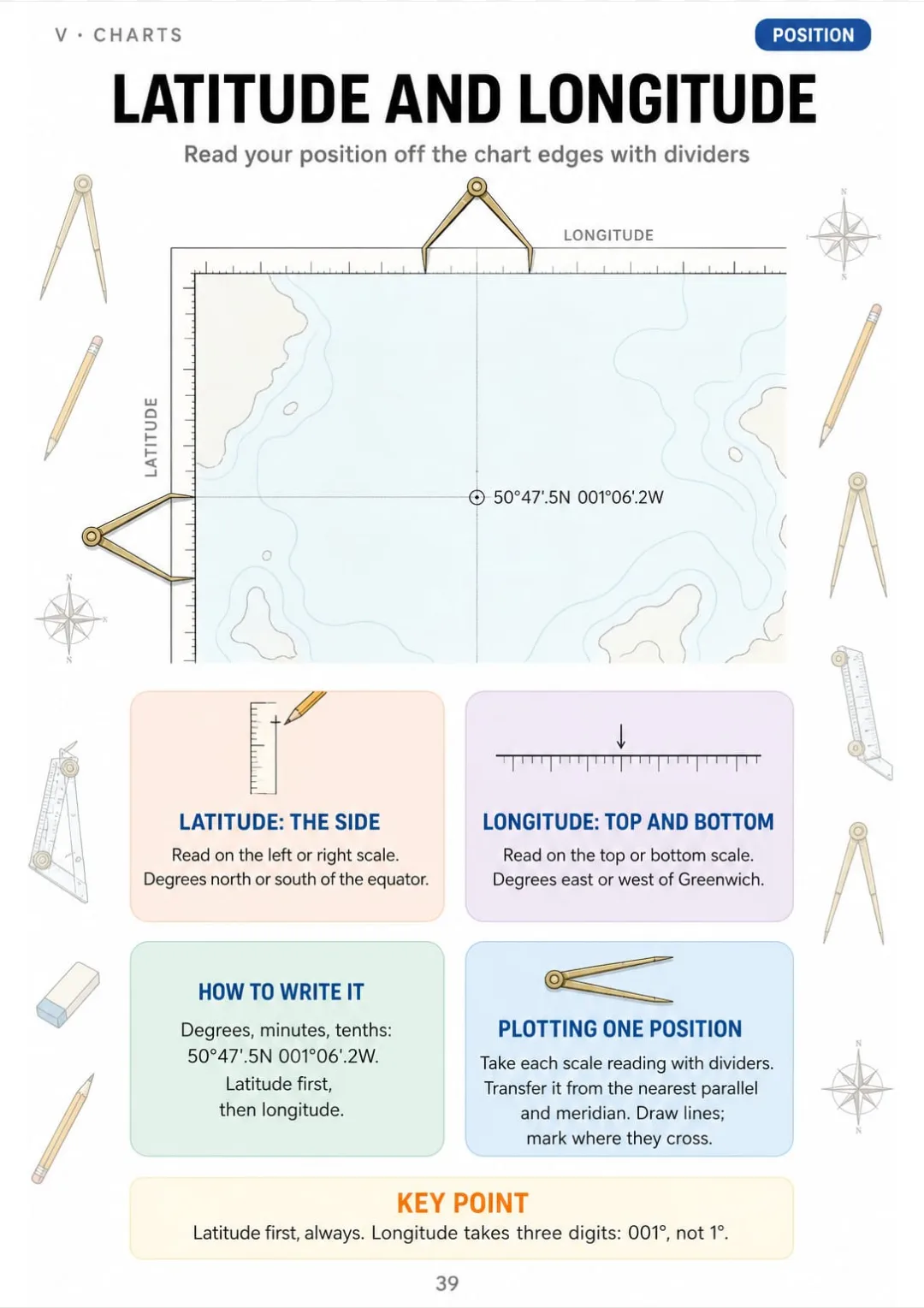
Latitude and longitude, measuring distance, chart symbols, true, magnetic and compass, speed, time and distance, fixing your position, DR and EP, and a course to steer across a tide.
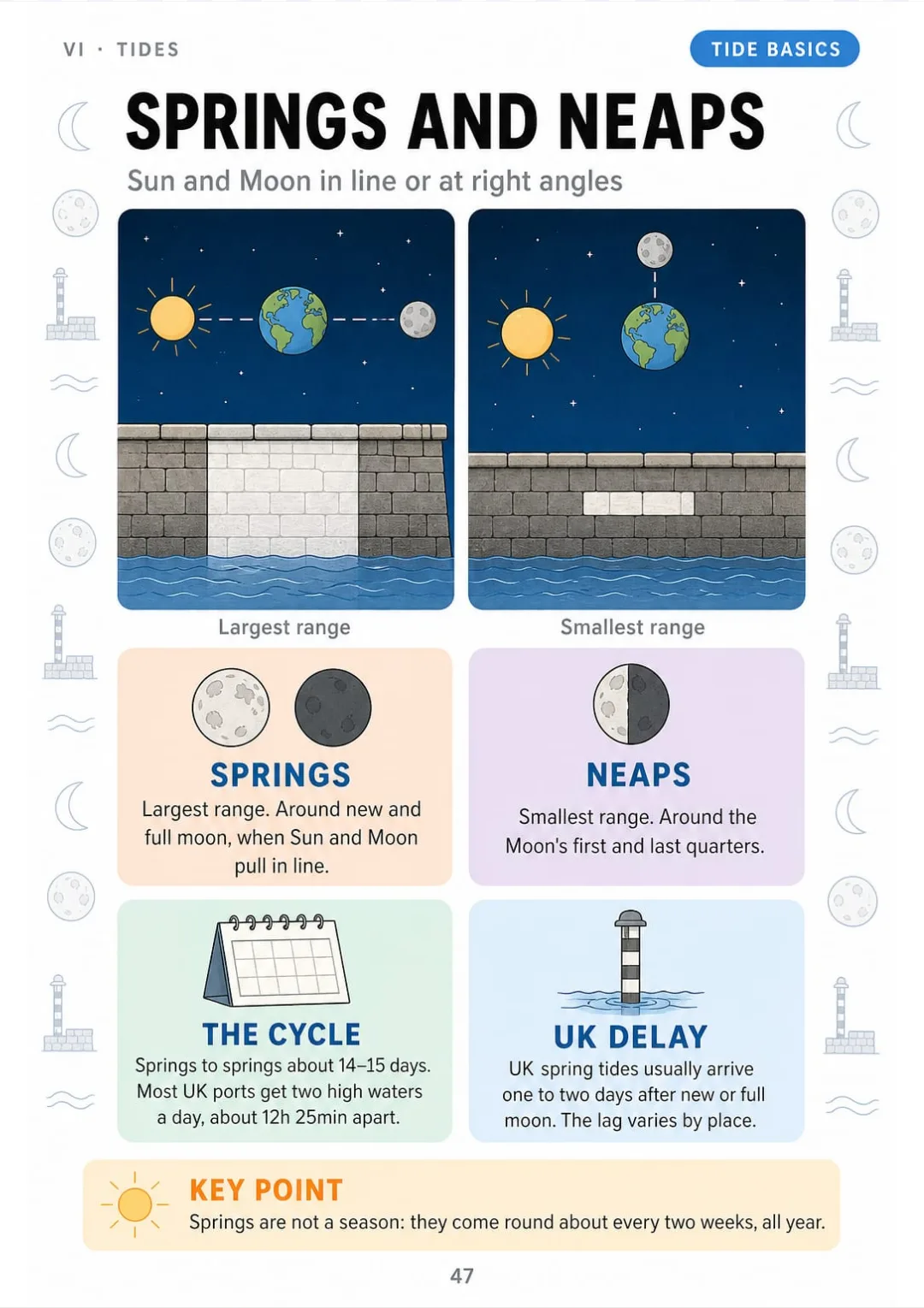
Springs and neaps, chart datum and height of tide, reading a tide table, the rule of twelfths with a worked example, secondary ports, tidal streams, under-keel clearance and wind against tide.
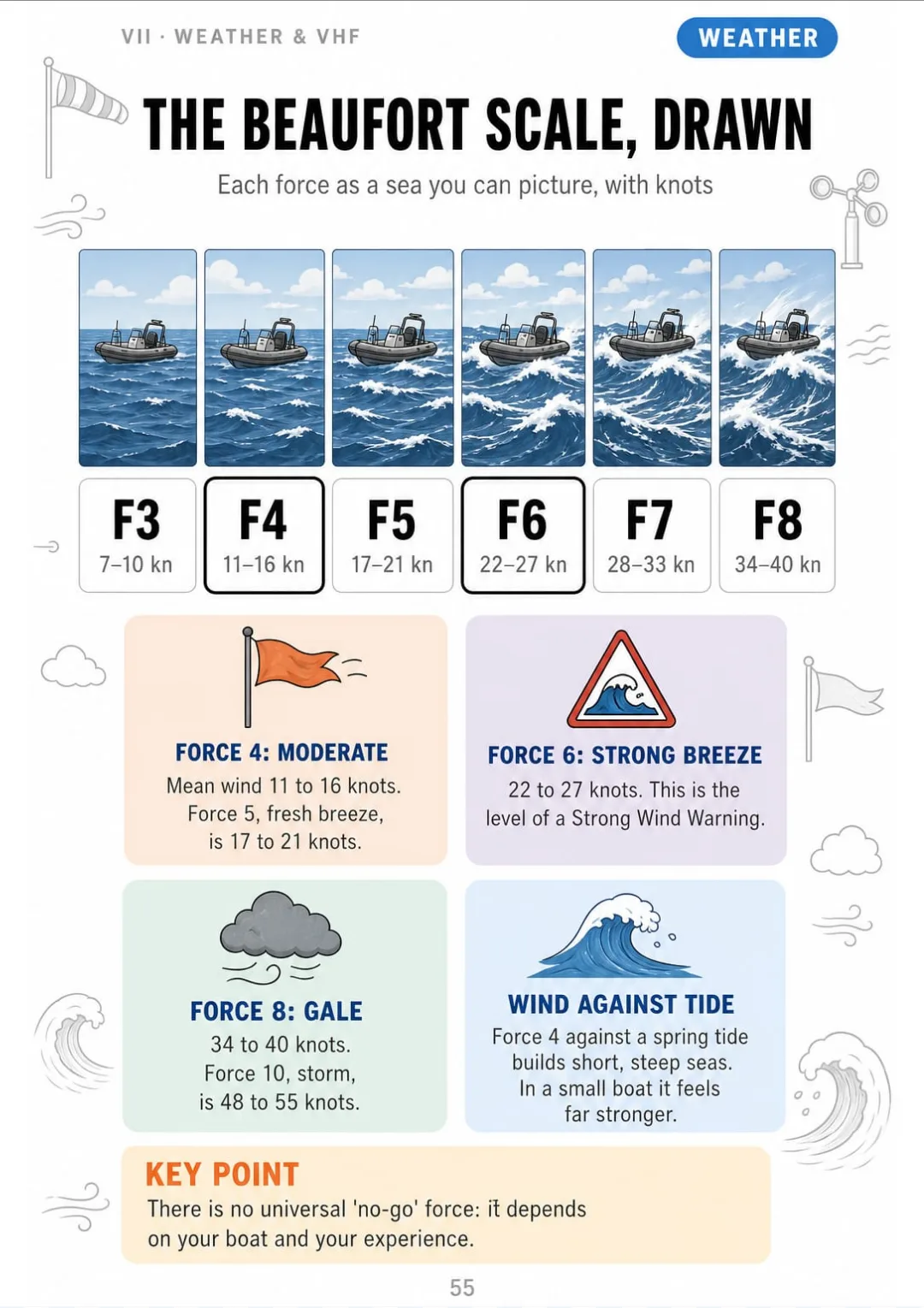
The Beaufort scale, getting the forecast, VHF channels and licences, the Mayday call word by word, DSC, Pan-Pan and Sécurité, man overboard, lifejackets and flares, and anchoring.
Lights at a glance, buoyage at a glance, the mix-ups people make most often, a pre-departure checklist and your last look before the course or test.
At the end of the book: Lights and buoyage at a glance, the most frequent mix-ups and a pre-departure checklist.
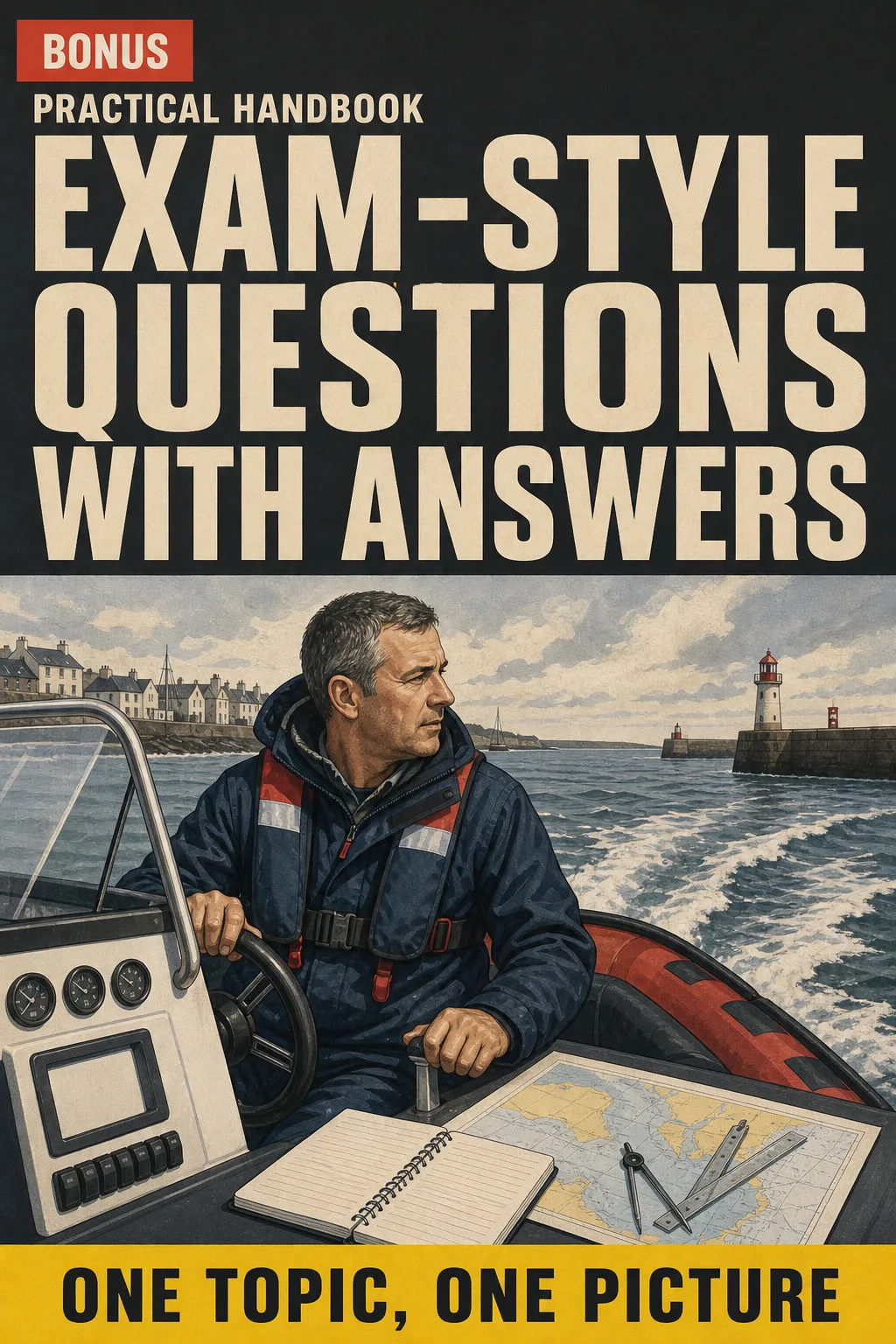
Test yourself on rules of the road, lights, buoyage and tides, and see why each answer is right, so you walk into your course or test knowing where you stand.

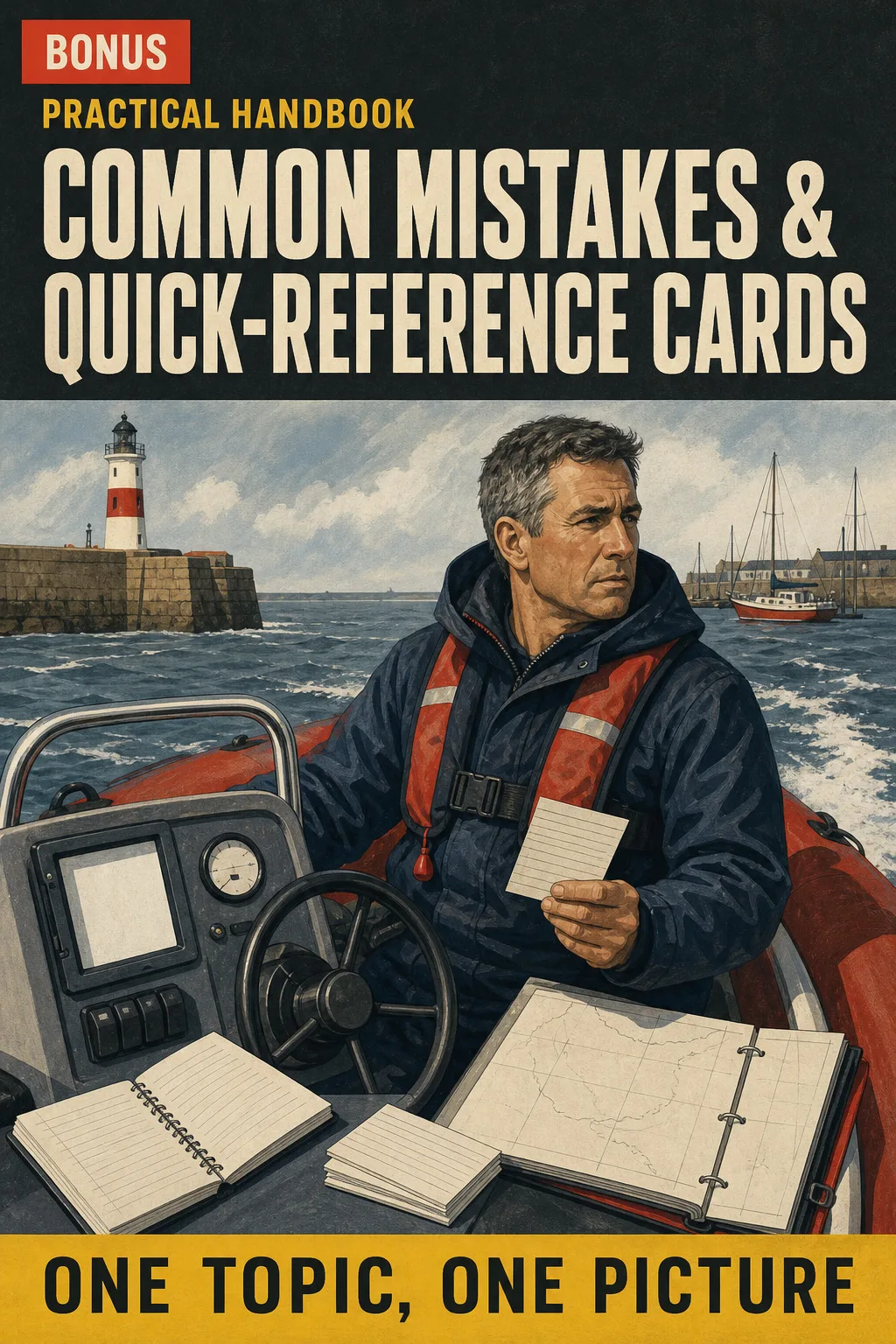
The most frequent mix-ups (port and starboard marks, cardinal topmarks, light sequences, sound signals) on cards you can print and keep on board.
📄 This is a digital PDF book sent to your email: nothing is printed or shipped.
PDF by email: We email you Powerboat & Day Skipper Illustrated as a PDF, together with the two free books. It's a single payment: no installments, no extra charges.
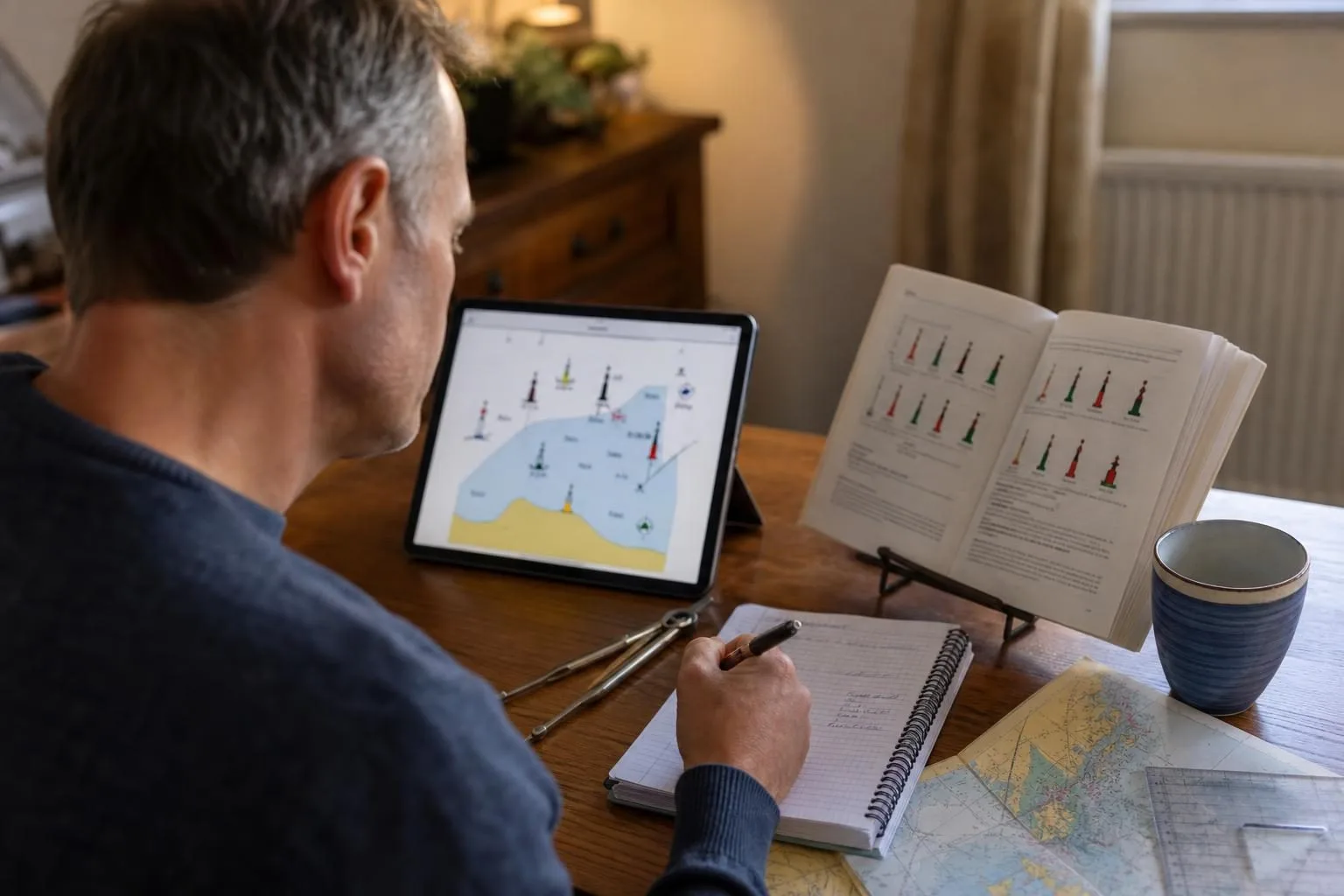
Each topic of the course on its own page, drawn, so the winter evenings of study are still there when you get on the water in spring.
Lights at a glance, buoyage at a glance and the most frequent mix-ups, to go over the night before and arrive knowing where you stand.
The rules you follow by instinct, finally drawn: who gives way, what each light means and why, to print and keep on board.
📄 This is a digital PDF book sent to your email: nothing is printed or shipped.
Try Powerboat & Day Skipper Illustrated for 30 days, bonus books included.
We refund everything if the file won't open, if the book isn't what you see here, if you were charged twice or if the email doesn't arrive. Just email us.
You pay once. No subscriptions.
It covers the theory those courses share: who gives way, lights, shapes and sounds, IALA Region A buoyage, charts, tides, weather and VHF. For the ICC it covers the coastal theory; it doesn't cover CEVNI, which you only need for European inland waterways. It starts from port and starboard, so it works whether you're new to it or have had a boat for years.
From the COLREGs 1972, as applied in the UK by the Merchant Shipping (Distress Signals and Prevention of Collisions) Regulations 1996 and MCA guidance, and from the IALA Maritime Buoyage System, Region A.
No. It's an independent study aid. It is not RYA material and is not affiliated with or endorsed by the RYA, the MCA or any awarding body.
No. It's for studying alongside your course or practical training, not instead of it. Handling a boat is learnt on the water with an instructor. If you need an ICC with an inland waterways endorsement, you'll also need the CEVNI test, which this book doesn't cover.
No. They're written for this book to help you check what you know. They aren't official questions from any course, exam or assessment.
The book and the 2 free books arrive as PDFs by email, to the address you give at checkout.
No. It's a one-off payment, with no subscription.
Yes. It's a PDF you can print at home or at a print shop, and keep the quick-reference pages on board.
You have 30 days. We refund everything if the file won't open, if the book isn't what you see on this page, if you were charged twice or if the email doesn't arrive: just email us.
No more rereading without it sinking in.
Lights, cardinals and who gives way: you see them drawn, and that's that.
You turn up to your course or test knowing where everything is.
Drawings make studying faster.
The book is right below.
One-time payment: US$ 27 · Guarantee: 30 days · PDF by email
YES, I WANT POWERBOAT & DAY SKIPPER ILLUSTRATED FOR US$ 27📄 This is a digital PDF book sent to your email: nothing is printed or shipped.